


Why VRAM Capacity Will Matter More Than GPU Power in 2026

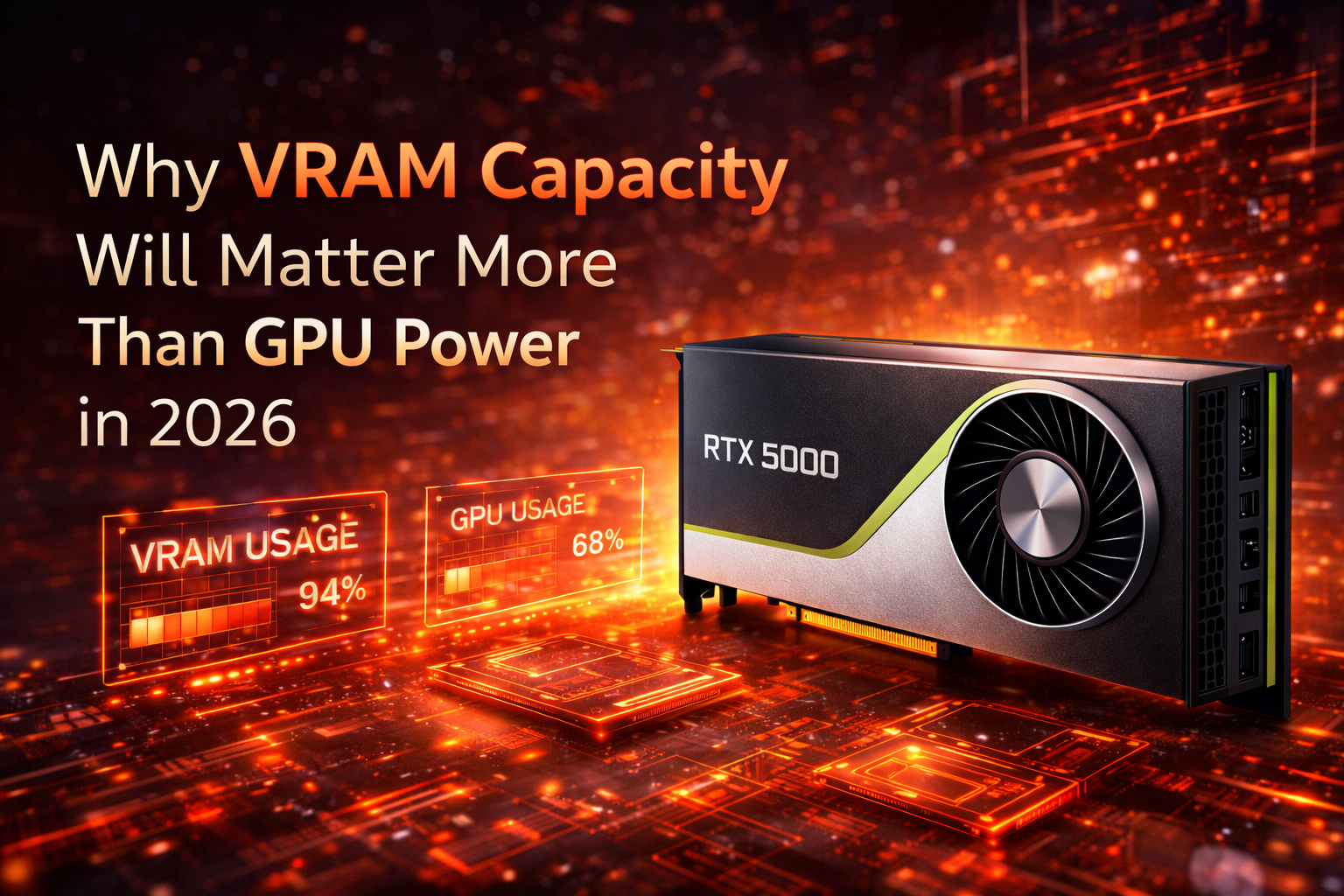
Why VRAM Capacity Will Matter More Than GPU Power in 2026: For many years, raw processing power was the primary metric used to evaluate GPU performance. Better gaming performance was typically associated with higher clock speeds, more cores, and stronger benchmark results. That relationship isn’t as solid as it used to be.
Memory behavior, which frequently occurs before a GPU’s compute capacity is fully utilized, has emerged as the main constraint on real-world gaming performance as contemporary game engines advance. By 2026, a graphics card’s longevity will be more influenced by its VRAM capacity and memory management than by its peak GPU power alone. This change isn’t hypothetical. Recent games’ behaviour on otherwise capable hardware already demonstrates it.
GPU Power Is No Longer the First Bottleneck
Performance in earlier rendering pipelines increased primarily with shader throughput. Frame rates increased predictably if a GPU could process more vertices or pixels per second. The majority of games fit comfortably within modest VRAM limits, and memory usage was comparatively constant.
This is no longer the case with modern engines. Large texture pools, sophisticated lighting systems, persistent world data, and constant asset streaming are all essential components of modern games. Even when the GPU is not operating at maximum capacity, these systems maintain a significantly higher amount of data in memory at all times.
Because of this, a GPU may still have unused processing power even as memory pressure impairs performance.
VRAM Usage Has Become Persistent, Not Situational
The fact that VRAM usage is no longer restricted to peak times like cutscenes or loading screens is a significant shift in contemporary engines. Rather, throughout gameplay, memory allocation stays high.
This happens because engines now:
- Maintain large texture pools to avoid visible streaming
- keep multiple material layers active simultaneously
- store lighting, shadow, and temporal data across frames
These systems do not aggressively scale down once they are operational. Even when graphical settings are decreased, VRAM usage remains near the engine’s internal target. Because of this, many users find that while lowering settings increases frame rate, VRAM consumption is not appreciably decreased.
Texture and Asset Pipelines Have Fundamentally Changed
Modern games are built using asset pipelines designed for high-resolution displays and future scalability. Textures are authored at very high resolutions and then streamed dynamically. Even when a game is played at 1080p, the engine may still keep large texture datasets in memory to ensure smooth transitions and prevent pop-in.
Additionally, modern materials are more complex. A single surface often requires multiple texture maps and data layers, all of which contribute to VRAM usage. This complexity accumulates rapidly in large scenes. The result is that VRAM requirements increase independently of screen resolution.
Advanced Lighting and Real-Time Effects Increase Memory Demand
Lighting systems have become one of the biggest drivers of memory usage. Techniques such as real-time global illumination, ray-traced shadows, screen-space effects, and temporal reconstruction require multiple buffers that persist across frames.
These buffers are not optional once enabled. They must remain in fast GPU memory to maintain frame pacing and visual stability.
While these techniques may not dramatically increase GPU utilization, they significantly increase VRAM usage and bandwidth demand. This is why enabling advanced lighting often triggers memory warnings long before GPU usage reaches 100%.
Why VRAM Shortages Feel Worse Than Low FPS
When a GPU runs out of VRAM, performance does not degrade gracefully. Instead, the system must constantly move data between GPU memory and system memory. This introduces latency and stalls that manifest as stuttering, inconsistent frame times, and delayed texture loading.
These issues are far more disruptive to the gaming experience than a stable but lower frame rate. This is why GPUs with slightly lower compute power but more VRAM often feel smoother in modern games than faster GPUs with limited memory.
Upscaling and AI Techniques Do Not Eliminate VRAM Needs
Upscaling technologies reduce the cost of rendering pixels, but they do not remove the need for large memory pools. Engines still need to store textures, geometry data, lighting buffers, and temporal history.
In some cases, upscaling introduces additional memory usage due to motion vectors, history buffers, and AI processing data.
Upscaling improves performance efficiency, but it does not reverse the underlying trend toward higher memory requirements.
Why Older GPUs Are Becoming Obsolete Faster
Many GPUs that remain computationally capable struggle with modern games because they lack sufficient VRAM headroom. As engines evolve, their baseline memory expectations increase. Once a GPU falls below those expectations, performance issues appear suddenly and persistently. This gives the impression that the GPU has “aged badly,” when in reality it is failing to meet new memory requirements rather than compute demands. This trend is accelerating, not slowing down.
What This Means for 2026 and Beyond
By 2026, GPU longevity will depend less on peak benchmark scores and more on how comfortably a card can handle modern memory workloads.
Cards with higher VRAM capacity and adequate memory bandwidth will:
- maintain smoother frame pacing
- tolerate engine updates and patches better
- handle future texture and lighting demands more gracefully
Conversely, GPUs that prioritize compute power over memory capacity may show strong early performance but degrade faster as engines continue to evolve.
Final Conclusion: Why VRAM Capacity Will Matter More Than GPU Power in 2026
Performance in the gaming industry is now more determined by memory behaviour than by GPU power alone. Large and dependable VRAM pools are necessary for modern engines to prioritise visual stability, streaming efficiency, and persistent world data.
By 2026, whether a GPU can render frames quickly enough without using up all of its memory will be more significant than how quickly it can do so. Making hardware decisions that are not only impressive at launch but also sustainable over a number of years requires an understanding of this shift.