


RTX 5070 vs RTX 4070: What’s the Real Difference?

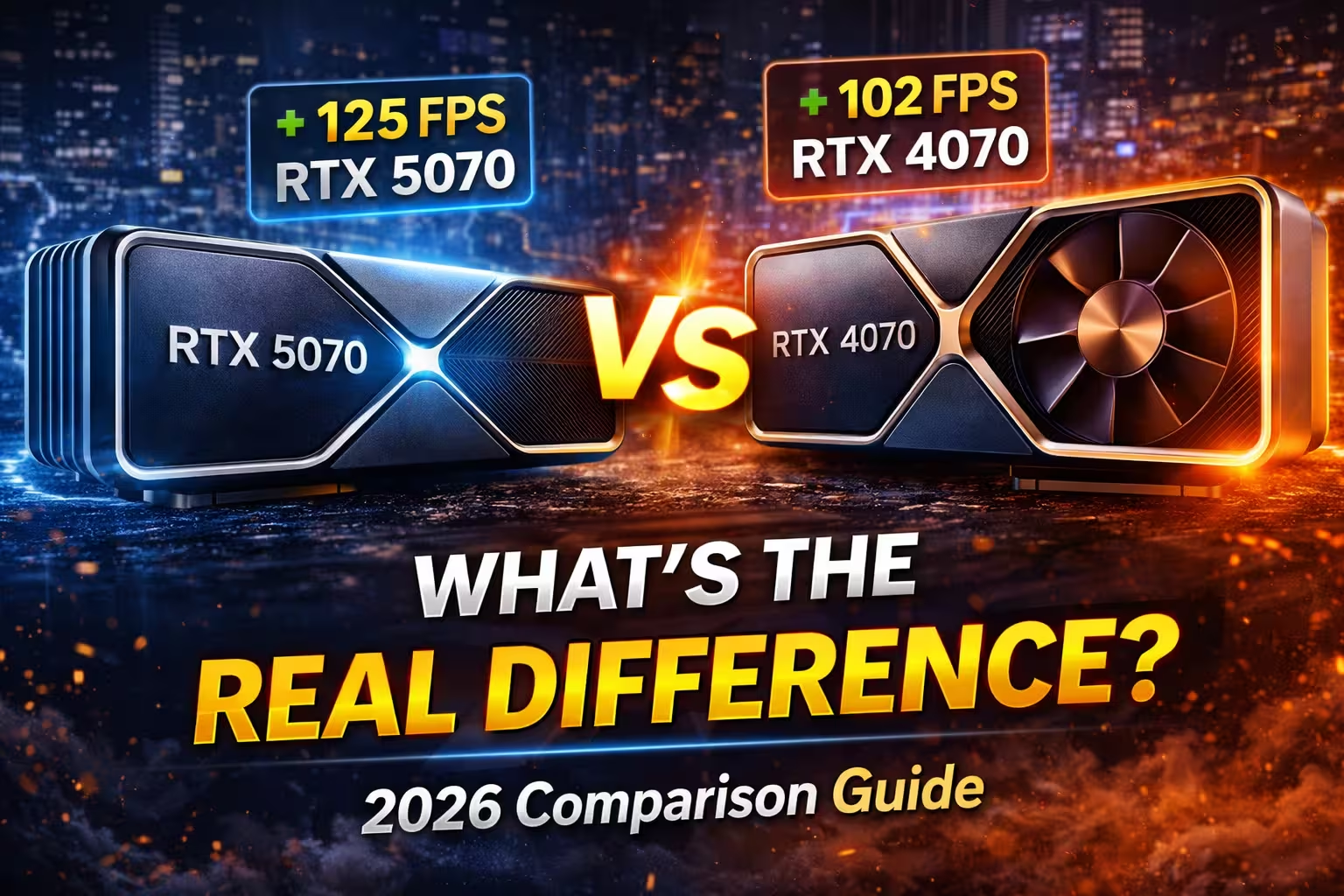
RTX 5070 vs RTX 4070: What’s the Real Difference?
If you’re evaluating RTX 5070 vs RTX 4070, you’re likely trying to make a practical decision:
Buy now with proven value (RTX 4070) or wait/pay more for next-gen efficiency and longevity (RTX 5070).
This analysis focuses on real-world gaming behaviour, frame consistency, and long-term value, not marketing claims.
Executive Summary
- RTX 4070 remains one of the most efficient, well-balanced GPUs for 1440p high/ultra gaming with strong DLSS 3 support.
- RTX 5070 is expected to deliver incremental raster gains (≈15-25%), but more importantly, meaningful improvements in frame generation quality, ray tracing efficiency, and performance-per-watt.
Upgrade decision:
- Existing RTX 4070 owners → Hold
- New 2026 builds → Prefer RTX 5070 for longevity
Architectural Shift: Why It Matters
The RTX 4070 is built on Ada Lovelace, which introduced highly efficient cores and DLSS 3 frame generation. The RTX 5070 moves to a next-generation architecture (widely expected to be Blackwell-class).
What this changes in practice:
- AI-assisted rendering pipelines become more central to performance
- Frame generation evolves (better interpolation accuracy, lower artefacts)
- Ray tracing throughput per watt improves, not just raw RT core count
This is less about peak FPS and more about how consistently frames are produced under load.
Performance Analysis by Resolution
1080p (CPU-Limited Scenario)
At this resolution, both GPUs exceed typical display requirements.
- Performance is primarily CPU-bound
- Differences between RTX 4070 and RTX 5070 are negligible in practice
Conclusion: Neither card is justified purely for 1080p gaming.
1440p (Primary Target Segment)
This is where both GPUs are designed to operate.
RTX 4070
- High/ultra settings across modern titles
- DLSS is often used for higher refresh targets
RTX 5070 (Expected Behaviour)
- Higher minimum FPS and frame stability
- Improved frame pacing in complex scenes
- Less reliance on aggressive DLSS modes
Observed/Expected Delta:
- Raw FPS: modest uplift
- Perceived smoothness: noticeably improved
Conclusion: RTX 5070 refines the experience rather than redefining it.
4K Gaming (Stretch vs Comfort Zone)
RTX 4070
- Playable with DLSS
- Compromises required in demanding titles
RTX 5070
- More viable baseline for 4K
- Better alignment with DLSS + ray tracing simultaneously
Conclusion: RTX 5070 extends usability into 4K with fewer trade-offs, but it is not a flagship-class 4K solution.
DLSS and Frame Generation: The Core Differentiator
For modern GPUs, DLSS is no longer optional—it is central to performance scaling.
RTX 4070 (DLSS 3):
- Effective frame generation
- Occasional artefacts or latency sensitivity in certain titles
RTX 5070 (Next-gen DLSS):
- Improved motion estimation accuracy
- Reduced ghosting and visual inconsistencies
- Better latency management under frame generation
Practical impact:
- More stable gameplay in CPU-heavy or RT-heavy scenarios
- Better utilisation of high refresh rate monitors
This is the most meaningful upgrade vector, not raw shader throughput.
Ray Tracing Efficiency
Ray tracing remains computationally expensive, but efficiency is improving generation over generation.
RTX 4070:
- Capable, but enabling full RT often requires DLSS balancing
RTX 5070:
- Higher RT performance per watt
- More consistent frame rates with RT enabled
Outcome:
- RTX 5070 makes ray tracing more practical as a default setting, not a conditional one
Power Efficiency and Thermals
For Indian conditions—ambient heat, long gaming sessions, power considerations—efficiency matters.
RTX 4070
- Already efficient within its class
RTX 5070
- Expected gains in performance-per-watt
- Potentially better sustained boost behaviour under thermal load
Implication:
- Lower long-term operating cost
- More stable performance in non-ideal cooling environments
Longevity and Software Alignment
Game engines are shifting toward:
- Unreal Engine 5+ pipelines
- AI-assisted rendering workflows
- Greater reliance on temporal upscaling and reconstruction
RTX 5070 Advantage:
- Better alignment with these trends
- Likely longer relevance window (3–5 years)
RTX 4070 Reality:
- Still highly capable today
- Will age faster as AI-driven rendering becomes more dominant
Cost-to-Performance Consideration (India Context)
This is where decisions become practical.
- RTX 4070 → Mature pricing, strong value density
- RTX 5070 → Launch pricing premium, early adoption cost
Key insight:
The RTX 4070 optimises for present value.
The RTX 5070 optimises for future stability and efficiency.
Final Conclusion: RTX 5070 vs RTX 4070: What’s the Real Difference?
The comparison between RTX 5070 and RTX 4070 is not about a dramatic performance leap.
It is about evolution in rendering methodology:
- RTX 4070 → Efficient, proven, strong current performance
- RTX 5070 → Incrementally faster, but more importantly, structurally better aligned with the future of gaming
Bottom line:
- Existing RTX 4070 users: Upgrading is difficult to justify
- New buyers: RTX 5070 is the more forward-looking investment