


The Role of Power Delivery in Long-Term Computer Stability

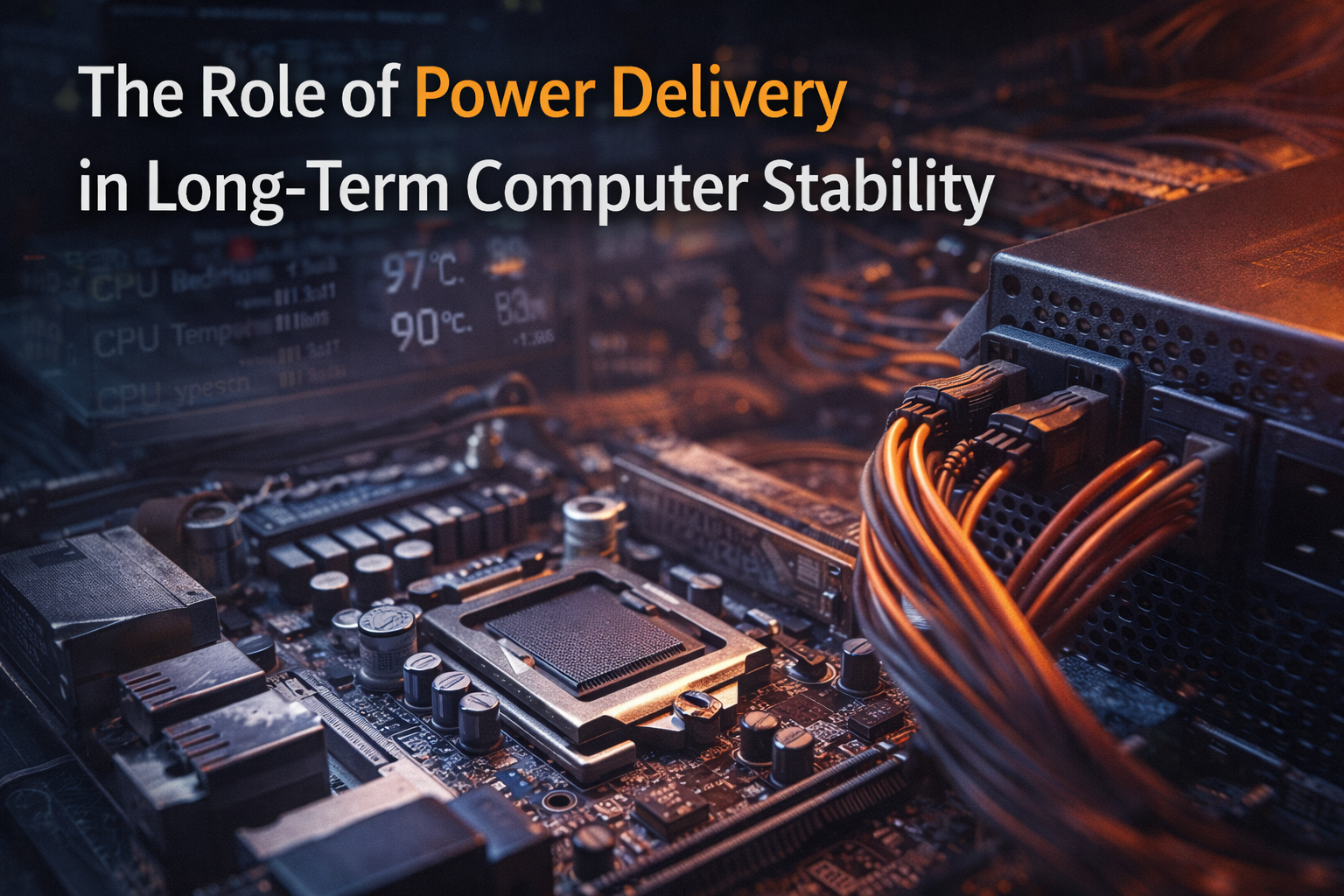
The Role of Power Delivery in Long-Term Computer Stability: Power delivery is one of the least understood yet most critical factors affecting long-term computer stability. While processors, memory, and storage receive the most attention during purchasing decisions, the quality and consistency of power delivery often determine whether a system remains stable for years or develops unpredictable issues over time.
Unlike visible components, power delivery problems rarely cause immediate failure. Instead, they introduce gradual instability, performance inconsistency, and component stress that accumulate silently. Understanding how power delivery works and why it matters is essential for building and maintaining reliable computer systems.
What Power Delivery Means in a Computer System
Power delivery refers to how electrical power is supplied, regulated, and distributed from the power source to individual components such as the processor, graphics card, storage devices, and motherboard circuits.
This process involves multiple stages:
- conversion of AC power to DC power
- voltage regulation and filtering
- current distribution under varying loads
Each stage must operate within precise electrical tolerances. Even small deviations can affect how components behave, especially under sustained or fluctuating workloads.
Why Stable Power Is More Important Than Peak Power
Many users focus on wattage ratings when selecting power components. However, long-term stability depends far more on voltage stability and response quality than on maximum power capacity.
Stable power delivery ensures:
- consistent CPU and GPU operation
- predictable clock behaviour
- Reduced electrical stress on components
Unstable power does not usually cause immediate shutdowns. Instead, it leads to subtle problems such as intermittent freezes, unexplained restarts, data corruption, and performance throttling.
The Power Supply Unit as the Foundation of Stability
The power supply unit (PSU) is the primary source of power delivery in a computer. Its role is not only to provide sufficient wattage, but also to deliver clean, well-regulated voltage under all operating conditions.
Lower-quality power supplies often exhibit:
- higher voltage ripple
- slower transient response
- reduced efficiency under load
These characteristics increase electrical noise and stress across the system. Over time, this stress accelerates component ageing and reduces operational stability. High-quality power supplies maintain tighter voltage regulation, better filtering, and faster response to load changes, which directly improves system reliability.
Voltage Regulation on the Motherboard
Once power reaches the motherboard, it must be regulated further before reaching sensitive components like the CPU and memory. This task is handled by the motherboard’s voltage regulation modules (VRMs).
VRMs convert incoming power into the precise voltages required by modern processors, which can change dynamically based on workload. Poor VRM design or low-quality components can struggle to maintain a stable output under sustained load.
As a result:
- CPUs may throttle earlier
- System stability may degrade under heavy workloads
- long-term component wear increases
Motherboard power design quality is, therefore, a major contributor to long-term stability, especially in systems that operate for extended periods.
Impact of Power Quality on Processor Behaviour
Modern processors rely heavily on precise power delivery to manage performance. Features such as boost frequencies and dynamic voltage scaling depend on the system’s ability to supply clean power quickly.
When power delivery is inconsistent:
- Processors may fail to reach intended performance states
- Boost durations shorten
- Micro-stutters or latency spikes may appear
These effects do not indicate processor failure. They are protective responses to electrical conditions that fall outside optimal parameters.
Over time, consistently poor power conditions can reduce overall system responsiveness without any obvious hardware fault.
Power Delivery and Storage Reliability
Storage devices, particularly solid-state drives, are sensitive to power irregularities. Sudden voltage drops or unstable power can interrupt write operations, increasing the risk of data corruption.
While modern storage devices include protection mechanisms, repeated exposure to poor power quality increases wear on internal controllers and memory cells. This can lead to:
- Slower sustained performance
- Increased error correction activity
- Reduced long-term reliability
Stable power delivery helps maintain predictable storage behaviour and data integrity over time.
Thermal Effects Linked to Power Inefficiency
Inefficient power delivery generates excess heat. This heat not only affects the power supply itself but also raisesthe overall system temperature.
Higher operating temperatures lead to:
- Reduced component lifespan
- Increased thermal throttling
- Higher fan speeds and noise
Even when cooling systems are adequate, poor power efficiency adds unnecessary thermal load, reducing the stability margin of the entire system.
Ageing and Power Delivery Degradation
All electrical components age. Capacitors, in particular, degrade over time due to heat and electrical stress. While ageing does not cause immediate failure, it reduces the system’s ability to handle sudden load changes.
As power delivery components age:
- Voltage stability margins narrow
- Transient response worsens
- Susceptibility to instability increases
This explains why systems with marginal power quality often develop issues after months or years, rather than immediately after purchase.
Why Power Delivery Issues Are Difficult to Diagnose
Power-related instability is often misdiagnosed because symptoms are inconsistent. A system may pass basic tests yet fail under specific workloads or environmental conditions.
Common misattributions include:
- Blaming operating system bugs
- Suspecting faulty RAM or storage
- Assuming software incompatibility
In reality, the underlying cause may be power delivery that is technically functional but electrically inadequate for long-term stability.
The Relationship Between Power Delivery and System Longevity
Long-term system stability is not defined by whether components work, but by how consistently they operate within safe electrical and thermal limits.
Reliable power delivery:
- Reduces electrical stress
- Stabilises performance behaviour
- Slows component ageing
Systems built with attention to power quality tend to maintain predictable behaviour for significantly longer periods, even as software demands increase.
Why Power Delivery Is Often Overlooked
Power delivery is invisible during normal operation. Users see performance specifications but not voltage ripple, transient response, or filtering quality. As a result, purchasing decisions often prioritise visible components while underestimating the importance of power infrastructure.
This oversight becomes apparent only when stability issues emerge over time.
Final Conclusion: The Role of Power Delivery in Long-Term Computer Stability
Power delivery is a foundational element of long-term computer stability. It affects how processors boost, how storage writes data, how components age, and how consistently a system performs under real-world conditions. Performance degradation and instability often arise not from failing hardware, but from power delivery systems operating outside optimal electrical margins. Clean, stable, and well-regulated power reduces stress across all components, improves reliability, and extends system lifespan.
Understanding the role of power delivery shifts the focus from short-term performance metrics to long-term system behaviour, which is essential for building dependable computer systems.